The Scout Method is a non-formal educational approach that helps young people learn and grow through experience, action, teamwork, reflection, and connection with nature. Rather than focusing only on theoretical learning, it encourages active participation and personal involvement.
Young people are not only taught what to think, but are given opportunities to explore, cooperate, solve problems, reflect on their experiences, and develop their own values and abilities.
At the heart of the Scout Method is the idea of learning by doing. This means that young people learn through direct experience: by taking part in activities, facing challenges, making decisions, and reflecting on what those experiences mean. This kind of learning is especially powerful in youth work because it is active, memorable, and connected to real life. Instead of receiving information passively, participants are encouraged to become active agents in their own learning process.
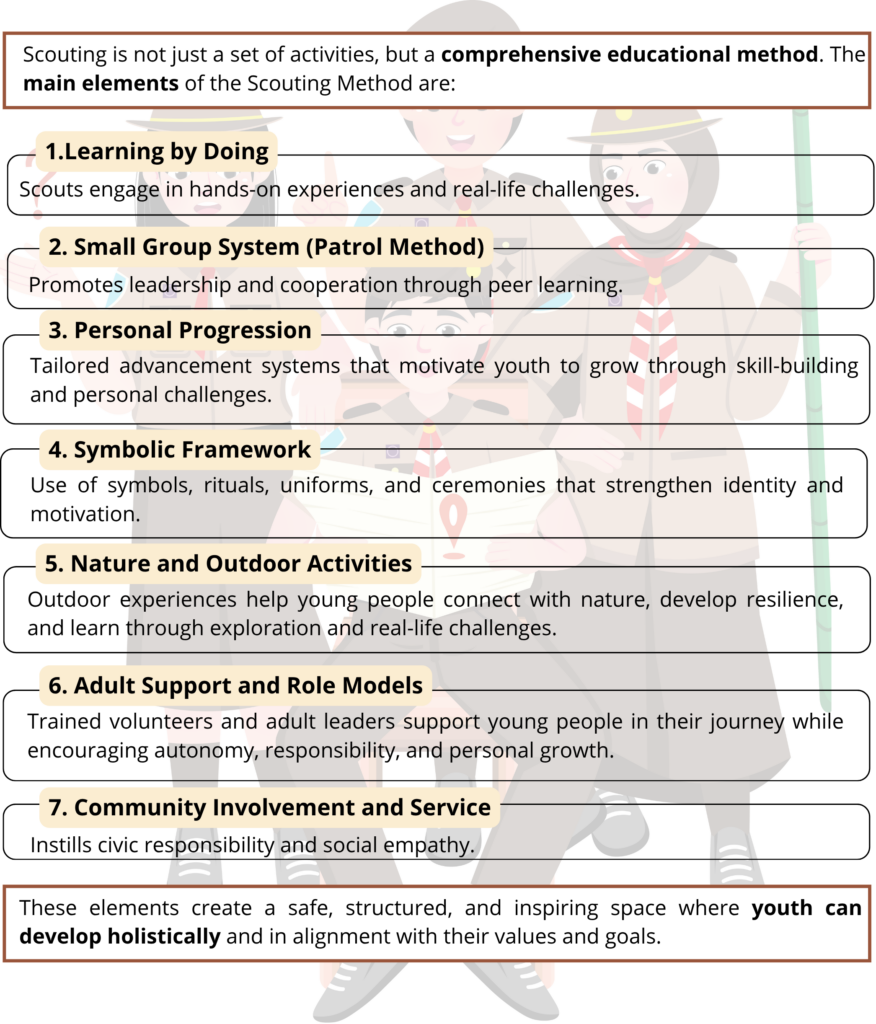
The Scout Method is built around several key elements that work together as a whole. These include learning by doing, small group work, personal progression, symbolic framework, adult support, nature and outdoor learning, and community involvement. Each of these elements contributes to young people’s development in a different but complementary way.
Small group work, often known as the patrol or team system, helps participants learn how to cooperate, communicate, take responsibility, and support one another. Working in smaller groups creates a stronger sense of belonging and makes it easier for young people to participate actively and confidently.
Personal progression focuses on individual development. The Scout Method recognises that each young person grows at their own pace. It encourages self-improvement, goal setting, reflection, and the gradual development of competences, confidence, and responsibility. Instead of competition with others, the emphasis is on becoming a better version of oneself.
Another important element is the symbolic framework, which includes shared values, symbols, traditions, rituals, and the Scout Laws and Promise. These elements help create identity, meaning, and connection. They also support learning by giving participants a shared language and value system through which they can better understand themselves, others, and their role in the group or community.
The Scout Method also places great importance on adult support. In this model, adults do not dominate the learning process, but rather guide, encourage, and accompany young people. They create safe and inclusive spaces where participants can learn, experiment, and grow while still developing their autonomy and initiative.